

How To Set The Hook On A Catfish
March fifteen, 2022
Catfish are elementary creatures. Catching them is simply a matter of putting a good bait in the right place at the correct time, using the best catfish rigs that can deliver and hold your bait in a location where active cats tin find it. The least number of components in the rig means fewer components to fail and knots to interruption, and less weight to interfere with a natural presentation. Simple catfish rigs also are easier to construct on the water when rigs are lost to snags or abraded leaders need replacing. And sparsely tied rigs cast farther and tangle less oft than more complex rigs designed to accomplish the same job.
All of this is not to say that simplicity is more important than function. Consider how the bait can best be presented to the fish, then choose the simplest, cleanest rig that volition put the bait in the correct location. The simplest rig of all consists of nothing more than a hook and bait, a setup used by Florida bass fishermen to freeline big live shiners under dense weedmats for bays largemouths.
This also is the rig favored past Al Lindner for big pre-spawn aqueduct cats on the Cherry-red River of the Northward. Sideslip a 2/0 hook through the corner of a freshly cut slice of sucker and bandage it into the centre of a shoreline eddy. The bait drops slowly through the water column, then tumbles forth lesser in the slow electric current.
Drift Rigs
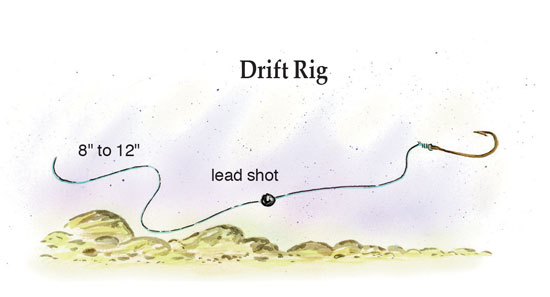
Most situations, though, call for a bit of weight for better casting distance and more than authentic allurement placement. A pb shot or two pinched on the line vi to 12 inches above the hook casts farther and drops to the lesser faster than a plain piece of bait, for fishing deeper h2o. Cast alongside a snag in light to moderate current, and the allurement moves slowly across the bottom, around the perimeter of the snag. This rig likewise is a good selection for drifting across shallow flats in lakes, ponds, or reservoir creek artillery. Use fresh cutbait and let the wind or current push the boat across the apartment toward deep water to intercept channel cats that cruise the shallows at night from late spring through early on fall.
Slipfloat Rigs
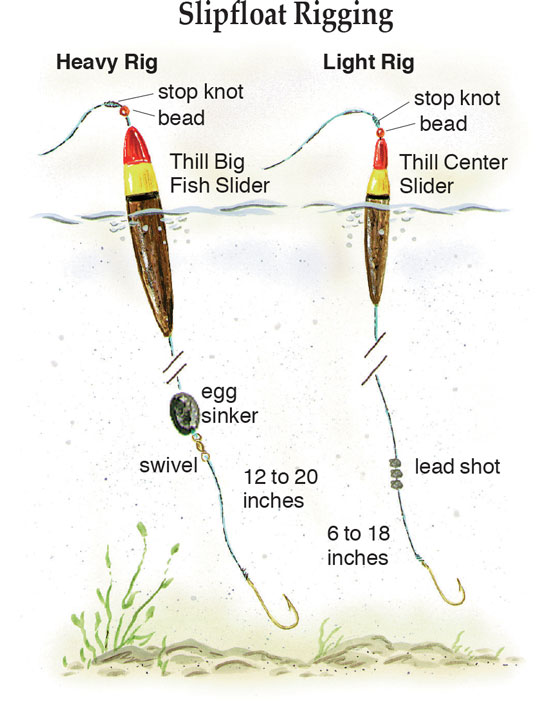
Bladder rigs also go along baits moving forth the bottom at current speed, but snag less frequently than shot rigs. Cigar-shaped slipfloats are more sensitive than round bobbers, assuasive cats to swim a short distance with a bait without feeling much resistance. Small, sparse designs like the classic Thill Middle Slider are perfect for drifting small to medium-size portions of cutbait for blue and channel cats, while the larger and more than bulbous Thill Big Fish Slider suspends large livebaits for flatheads.
Regardless of which catfish species you're fishing for, the bones slipfloat rig is constructed in the same way. Earlier tying on a hook, tie a 5-plough Uni-knot around your main line with the same or slightly heavier line, to serve equally an adjustable bladder finish. Sliding the end knot upward the line makes the allurement run deeper, while sliding information technology downwardly allows for a shallower drift. Next, slip on a 5-mm dewdrop followed past the slipfloat. Anchor cutbait and smaller livebait rigs with a few lead shot nearly a foot in a higher place a hook, ranging from a #2 for pocket-sized baits to a iii/0 for bigger baits. To anchor larger livebaits for flatheads, add a swivel about 20 inches above a 3/0 to 7/0 hook. Slide a 1- to 2-ounce egg sinker on the line to a higher place the swivel to balance the bladder.
Slip Rigs
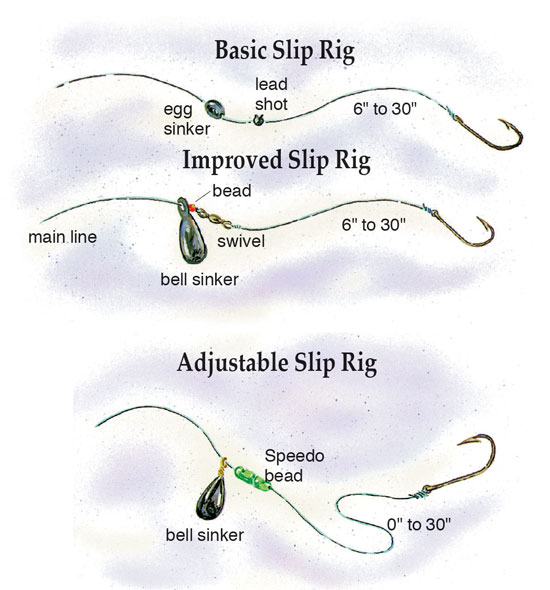
Every bit versatile and effective equally migrate and float rigs frequently are, many catfishing situations call for live or dead allurement yet fished on the bottom. The most pop lesser rig for all species of catfish is the egg sinker sideslip rig. The object of this rig, which consists of an egg sinker sliding on the chief line held in identify to a higher place the hook by a lead shot, is to keep the bait well-nigh the lesser and permit a cat to swim off with the bait with little tension. While the basic idea behind this rig is sound, it doesn't achieve either objective well.
The success of limb lines and pole lines makes it obvious that catfish aren't timid feeders like trout or walleyes who need to run a short altitude on a freeline before engulfing the bait. When a decent-size cat picks upwards the allurement, he has it. Virtually of the time, you lot could set immediately without giving any line. But your chances of a solid hookset in the corner of the cat's mouth increase if you let the fish turn to the side before setting. Just be certain to go on abiding tension on the line after the fish picks upwardly the bait. When you feel the thump of a fish grabbing the bait, follow him with your rod tip for a foot or ii, and so gear up. If your rod's in a rod holder with the bait clicker engaged, let the fish take a foot of line, so engage the reel and prepare.
Some other problem with the egg sinker rig is the egg sinker. Egg sinkers work well when pitched directly behind a boat anchored in current. When cast across current, however, they tend to ringlet along the bottom and snag more often than sinker designs like bong or banking concern sinkers. Slip your main line through the top of the the sinker and supersede the carve up shot with a swivel to vastly improve the efficiency and effectiveness of the slipsinker rig. Instead of a swivel, use a Speedo Dewdrop from U.Due south. Tackle (618/997-5049) as a sinker terminate to make an adaptable slip rig that allows for varying the length of the leader without retying. If y'all opt for a swivel, add together a small dewdrop to your primary line to protect the knot connection from the sliding sinker.
Recommended
Leader length, past the way, often is a subject area of concern for novice catfish anglers. Don't employ a longer leader just to separate the allurement from the sinker. To catfish, a sinker is just some other rock. Rather, adjust the length of the leader to vary the amount of action and motion imparted to the bait. A piece of cutbait tethered on a 12-inch leader may lie motionless on the bottom of a lake or pond, merely would flail about wildly in heavy current. Use just enough leader to let your bait attract fish without hanging upwards. That may mean a xxx-inch leader for drifting cutbait across the clean bottom of a reservoir for blueish cats; a vi-inch leader for property large live baits in forepart of a snag for flatheads; or no leader at all for probing the cleaved bottom of a tailwater for channel cats.
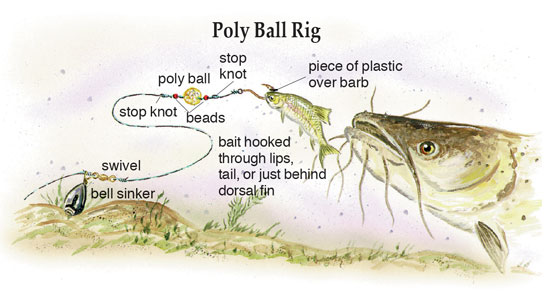
Poly Brawl Rigs
In some situations, y'all want the bait anchored in identify, but off the bottom. Live baits that are kept up and swimming concenter more fish than baits that cower under cover. And deadbaits suspended to a higher place lesser debris are easier for fish to locate. The floating jig heads used by walleye anglers work well for crawlers, leeches, and small pieces of cutbait, but no jig head is buoyant plenty to lift larger baits. That'south the idea behind the English poly brawl rig. Simply slip a 1- to two-inch styrofoam (poly) ball on the leader and rig information technology in sideslip float fashion so the ball can be moved closer or farther from the bait. Tie your own rigs with poly balls from EuroTackle (203/874-7107).

Three-Fashion Rigs
The 3-mode or Wolf River rig is one of those rigging options that's and then versatile information technology should at least be considered in about situations for all catfish species. It'due south an constructive rig for presenting static baits in the heavy current of a tailrace, or the still waters of a lake or swimming. Simply information technology'south unparalleled for slipdrifting on large rivers like the Mississippi, Missouri, and Ohio, and for drifting current of air-blown flats in large reservoirs similar Santee Cooper.
The three-way rig consists of a dropline some 6 to 24 inches long, anchored by a bell sinker of sufficient weight to keep the chosen bait virtually the bottom. A half-ounce sinker is sufficient in still h2o, only iii to 8 ounces may exist needed to migrate around the tips of wing dams for blue and channel cats or for anchoring livebaits in a heavy tailrace for postspawn flatheads. The leader should be slightly longer than the dropper line" normally ii to 3 feet, depending on current velocity.
3-way rigs also excel at extracting fish from areas where other rigs can't agree or return. Let's say you're line-fishing for channel cats over a broken-stone lesser below a low-head dam. Utilise a iii-way rig with a 20-pound-test master line and a 17-pound-exam leader. Secure a 2- to 4-ounce bong sinker to i ring of a barrel hinge or the bottom ring of a three-way swivel with half-dozen-pound-test line. Cast this rig into place, and the sinker hangs on the bottom and holds the rig in place until a fish strikes. Big cats frequently take hold of a bait hard enough to hook themselves and quickly break the low-cal dropper line. When a smaller true cat hits the bait, a sharp hookset will pause off the sinker and then the rig and fish tin can be landed.
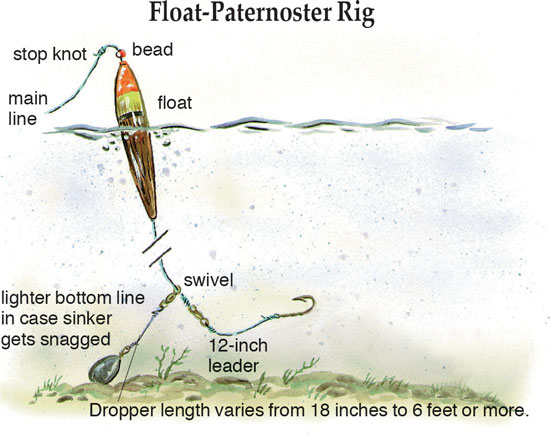
Paternoster Rigs
The paternoster rig is a sort of three-way sideslip rig well worth the actress time needed to tie it in many situations, peculiarly for presenting livebaits to flatheads. The low-frequency vibrations produced by a struggling baitfish attract catfish by stimulating their sensitive lateral lines. Livebaits of all sizes must start be wild and super lively, and second be presented in ways that allow them to advertise these seductive qualities. Keep a wild bait suspended to a higher place encompass and it feels "rightly so" exposed, vulnerable, and panicked.
Begin with a terminal leader as you would with an improved slip rig a 12-inch section of monofilament or dacron with a hook on one end and a barrel swivel on the other. Before tying the swivel to your chief line, though, add a pb dropper consisting of a slightly lighter piece of monofilament with a bong sinker on one end and a swivel on the other. Thread the dropper swivel on the main line and so information technology slides above the leader hinge. The length of the bottom dropper determines how high the bait will suspend off the bottom.
Paternoster rigs are most effective when you can maintain a 30- to 90-degree bending on your line, from rod tip to sinker. Fishing the head of a pigsty from a gunkhole anchored slightly upstream; or line-fishing the edge of a apartment from the sandbar on an exterior river curve; or fishing the scour hole behind a bridge abutment from the acme of the bridge all are top situations for paternoster rigging. Breakaway Tackle (512/729-0777) offers a pre-tied paternoster rig called the Long Ranger. Designed for surf casting, this rig includes an impact shield, a small plastic prune that holds the hook during the bandage. This, says Breakaway'due south Nick Meyer, keeps the leader from tangling and increases casting distance by ten to 25 percent. The rig is ideal for tailraces and other distance-casting situations.
Bladder-Paternoster Rig
This rig is a pinnacle selection when the situation calls for placing a big bait in the lair of large fish and waiting them out. Editor-In-Main Doug Stange credits this rig with the biggest flatheads he's defenseless during the last several seasons. The fish were taken from large eddies just behind huge piles of snaggy timber lining deep river holes. With either a vii-inch bullhead or 12-inch wild sucker as bait, Stange tosses the offering into the heart of the eddy, merely away from any snags. It as well is constructive when y'all're gear up up on a shallow point in a reservoir, in the corner of a large swimming, or somewhere in the dorsum stop of a creek arm. Prod the float from fourth dimension to time to keep the suspended baitfish pond.
Float-paternoster rigging employs a slipfloat, then to make the rig, begin as you would a standard slipfloat rig slipknot, bead, then slipfloat. Unlike a standard slipfloat rig, however, the sinker rests on the bottom, and the float need just suspend the weight of the bait and go along it pond. This allows for the use of a smaller, more-sensitive float. Side by side, add the lead dropper, bead, and leader. Suit your floatstop for a little play in the leader, allowing the bait to swim a big circle and slightly off to the side. A tightly tethered bait doesn't swim so vigorously as a allurement that believes information technology's going somewhere.
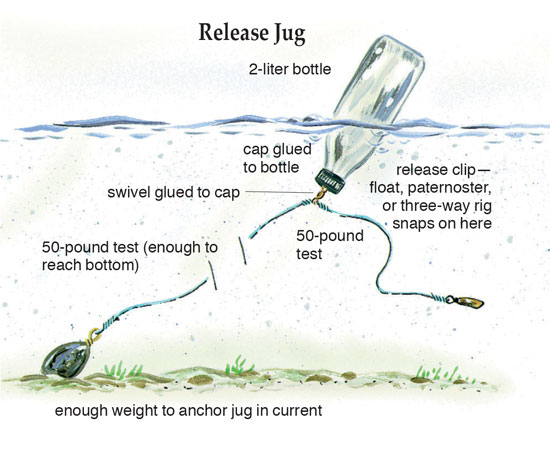
Release Rigs
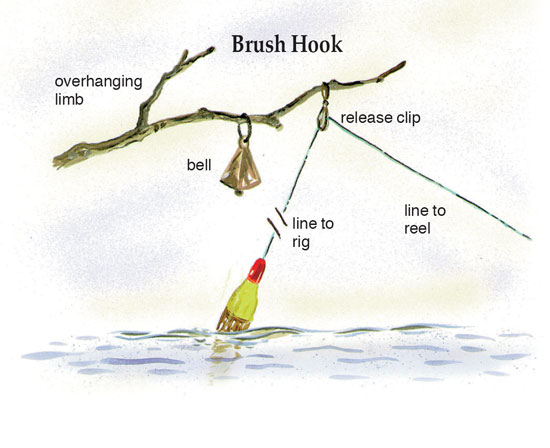
Release rigs aren't terminal rigs, but a way to deploy terminal rigs based on the limbliner's arroyo. Master catman Ed Davis has used this system to catch the Due north Carolina country record flathead and blue cat, and several line-class world records. Davis uses multiple rods to encompass several areas and experiment with different baits. At least one line is a brush hook a release clip tied to a branch hanging over the h2o. The line is attached to the clip so the allurement swims freely (livebait) or drifts (cutbait) in the upper half of the water cavalcade. Davis usually uses a slipfloat rig, just a three-style or paternoster rig may be more than effective for presenting livebaits. Necktie a bell on the limb to betoken strikes after dark. When a cat takes the bait, the bell rings and the line pulls gratuitous from the clip.
Davis also catches big blues and flatheads nigh the surface over deep holes in the river channel. Instead of parking his boat over the pinnacle of the hole and line-fishing straight downstream, Davis employs a release jug, which consists of a two-liter bottle with a large barrel swivel glued to the cap. A length of 50-pound line is attached to a heavy bank sinker or decoy weight to anchor the jug in current. Another shorter line is tied to a release prune. Once the jug'due south in position, a baited rig is attached to the clip. Utilize a bladder rig to suspend baits near the surface, or a paternoster rig to keep baits swimming a foot or two off bottom.
Other boats on the river after dark nowadays a problem when lines are spread across the river. A ring of cogitating record makes the jug visible to boaters, just lines running merely beneath the surface remain a problem. Instead of retrieving lines when a gunkhole approaches, adhere a clothespin or prune-on weight with a one-ounce sinker to the lines and disengage your reel. The weight is enough to drop the line below the surface to let boats pass, only not enough to trip the release on a jug or limb prepare.
There are, of form, endless refinements to these and other last rigs to assistance yous grab more and bigger cats in a item situation. Consider the conditions you encounter on the water and modify standard rigs to improve your presentation. Permit united states of america hear about your successes. And await to future Catfish Guides, the Catfish In-Sider, and In-Fisherman magazine for refinements to top riggings.
Big Ten Tackle Magnetic Bobber

Class Night Rider

R.J. Tackle (Class), 941-693-7070
Fuji Lighted Slip Bobber

Gapen Big Game Floats

Lindy-Footling Joe Pole Float

Plastilite Pencil Bladder

Plastilite Tubular Bladder

Rainbow Plasticone In Line Bobber

Rainbow Plasticone Slip Bobber

Rainbow Slip Fashion

Rainbow Super Float

Thill Center Sliders

Thill American Archetype

Thill Large Fish Sliders

Thill Bodied Wagglers

Thill Fauna Forcefulness

Thill Glow float

Wing-information technology Bobber

Source: https://www.in-fisherman.com/editorial/best-catfish-rigs/153985
0 Response to "How To Set The Hook On A Catfish"
Post a Comment